
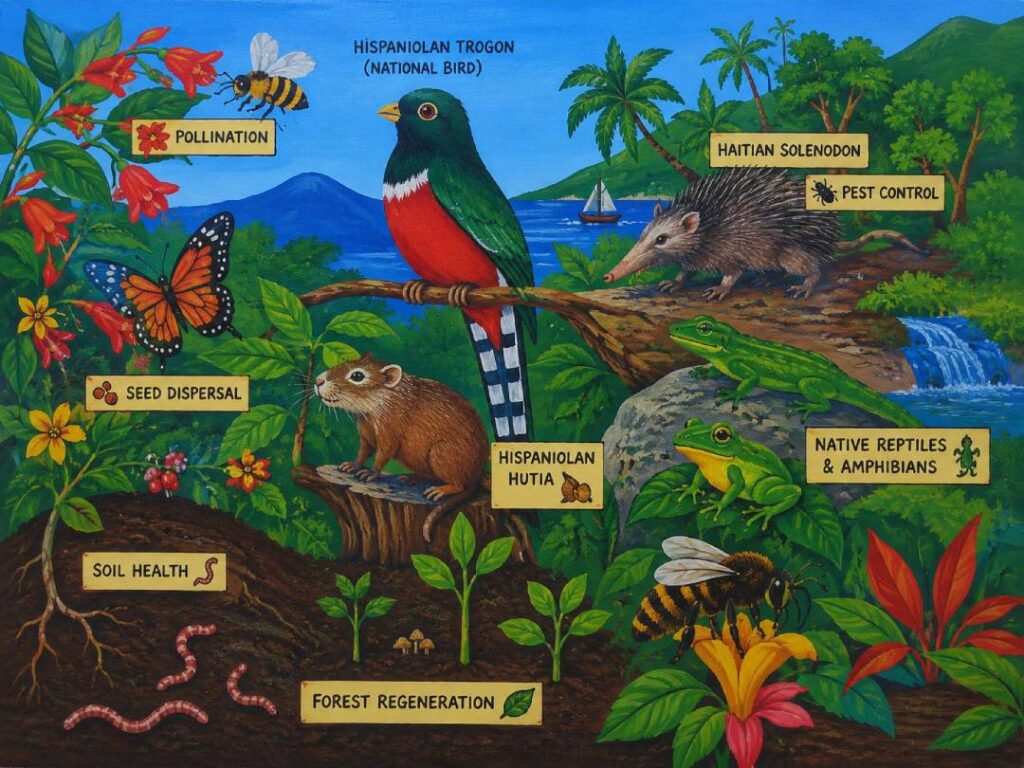
Meet Haiti’s Unique and Endemic Wildlife: The Resilience Workforce
When we think of Haiti’s mountains, we often see them as silent, stony giants. But for those who know where to look, these landscapes are alive with a “hidden workforce.” Haiti is home to an extraordinary array of endemic wildlife—species found nowhere else on the planet—that play a vital role in keeping the environment functioning.
For a donor, these animals are more than just biological curiosities. They are the active agents of restoration. In a country where deforestation has stripped the land, the survival of native wildlife is directly linked to the success of reforestation. These animals are the ones who plant the trees that humans cannot reach, and they are the ones who protect the crops that smallholder farmers rely on for survival.
The Short Answer
Haiti’s fauna is a specialized “workforce” that provides essential ecosystem services.
- Natural Reforesters: Endemic birds and bats disperse seeds across steep, inaccessible mountain slopes, allowing forests to regenerate naturally.
- Pest Controllers: Native lizards and frogs act as an organic shield for agriculture, consuming the insects that would otherwise destroy crops.
- Soil Architects: Small mammals like the Solenodon aerate the soil as they forage, helping water penetrate the ground and reducing soil erosion.
- Keystone Indicators: The presence of these species tells us if a watershed is healthy enough to support human life and agriculture.
The core thesis is that protecting Haiti’s wildlife is a strategic investment in the “maintenance crew” of the landscape; without them, the systems of water and soil stability eventually fail.
Haiti’s Keystone Workers
| Species | Their Role in the System | Why Their Loss Matters |
|---|---|---|
| Hispaniolan Solenodon | Insectivore / Soil Aerator | One of the world’s last venomous mammals; its loss leads to soil compaction and insect imbalances. |
| Hispaniolan Trogon | Seed Disperser | Haiti’s national bird; it is a primary “reforester” that spreads the seeds of native trees. |
| Hispaniolan Parrot | High-Altitude Seeder | Essential for the health of highland forests, moving seeds between isolated forest fragments. |
| Eleutherodactylus Frogs | Nocturnal Pest Control | Haiti has some of the highest frog diversity in the world; they are the primary check on mosquito and agricultural pest populations. |
| Rhino Iguana | Dry-Forest Seed Spreader | Crucial for the survival of dry forests, helping native plants germinate through their digestion process. |
The Systemic Loop: Fauna and Forest Recovery
Wildlife doesn’t just live in the forest; it creates the forest. This relationship is a critical “feedback loop” that helps determine whether the land can recover from natural disasters.
The Restoration Workforce Cycle:
- Animal Activity: A bird eats a fruit from a native tree in a protected valley.
- Seed Dispersal: The bird flies to a bare, eroded slope and deposits the seed along with natural fertilizer.
- Forest Regeneration: The seed grows into a tree on a slope where humans could never safely plant.
- Landscape Stabilization: The new tree’s roots hold the soil, preventing severe soil erosion.
- Habitat Expansion: The growing forest provides more space for the bird to thrive, repeating the cycle of natural recovery.
Donate to Haiti
Your gift will help address food security and economic development in Haiti. $100 can help give a Haitian family seeds for planting their own crops. $150 can provide a rooster and a hen for a family to begin breeding chickens.
What Happens When the Workforce Disappears?
When we lose these species, we don’t just lose an animal; we lose the service they provide for free. In environmental economics, this is known as the loss of “ecosystem services,” and in a country with limited resources like Haiti, this loss has an immediate, devastating impact on human survival and the economy.
The Agricultural Cost of Losing Pest Controllers
Consider the role of native frogs, bats, and lizards. They are the frontline defense against agricultural pests. When their populations collapse due to habitat loss, insect populations explode. For the Haitian farmer, this means crops are destroyed before they can be harvested. To compensate, farmers are forced to spend money they don’t have on chemical pesticides. These chemicals further degrade the soil and run off into the water supply, creating a secondary health and environmental crisis while keeping the farmer trapped in debt.
The Reforestation Bottleneck
Haiti’s mountains are steep, rugged, and notoriously difficult to access. Human-led reforestation efforts are vital, but planting trees by hand across millions of acres is slow, expensive, and dangerous. Endemic birds and fruit-eating bats are nature’s free planters. They consume seeds and distribute them across inaccessible ravines and high-altitude ridges. Without these creatures, reforestation becomes entirely dependent on manual labor and funded nurseries. The Haiti endangered species crisis essentially grinds the natural replanting process to a halt.
The Decline of Soil Health
Ground-dwelling mammals like the Solenodon play a critical role in soil aeration. As they dig and forage for insects, they loosen the earth, allowing rainwater to penetrate deep into the aquifers. When these animals disappear, the soil becomes compacted and hard. When the heavy rains come, the water no longer sinks in; it runs off the surface, accelerating flash floods and worsening the impact of climate change.
This is why biodiversity loss is so dangerous. It removes the “immune system” of the environment. Every lost species is a broken gear in the machine that keeps Haiti’s landscape stable.
Joining Hands with The Haitian Development Network Foundation
The Haitian Development Network Foundation (HDN), a registered U.S. 501(c)(3) nonprofit, understands that protecting wildlife is a key part of our sustainable development roadmap. We work to protect the habitats these species need so they can continue their work for Haiti.
Through its IRS-approved intervention areas, HDN supports the systems that protect Haiti’s fauna:
1. Agroforestry and Habitat Restoration
HDN supports agroforestry systems that provide “biological corridors”—paths of trees that allow animals to move safely between forest fragments.
2. Watershed Protection and Clean Water
By keeping soil in the mountains, we protect the clean streams that are essential for the survival of Haiti’s unique amphibians and aquatic life.
3. Clean Energy to Stop Habitat Loss
Our waste-to-energy initiatives reduce the need for charcoal, directly stopping the destruction of the old-growth forests that species like the Solenodon and Trogon require.
4. Technical Training and Community Stewardship
HDN provides technical training to local communities, empowering them to act as the stewards and protectors of their own local wildlife.
5. Rural Infrastructure and Resilient Livelihoods
By building stable rural systems, we reduce the economic pressure on families to clear sensitive habitats for survival, protecting the home of Haiti’s “hidden workforce.”
Ready To Support Haiti’s Natural Workforce?
Haiti’s wildlife is the invisible engine of environmental recovery. By supporting the systems that protect these species, you are helping to ensure that the work of restoration continues, even in the most remote corners of the mountains.
Donate to Haiti
Your gift will help address food security and economic development in Haiti. $100 can help give a Haitian family seeds for planting their own crops. $150 can provide a rooster and a hen for a family to begin breeding chickens.