
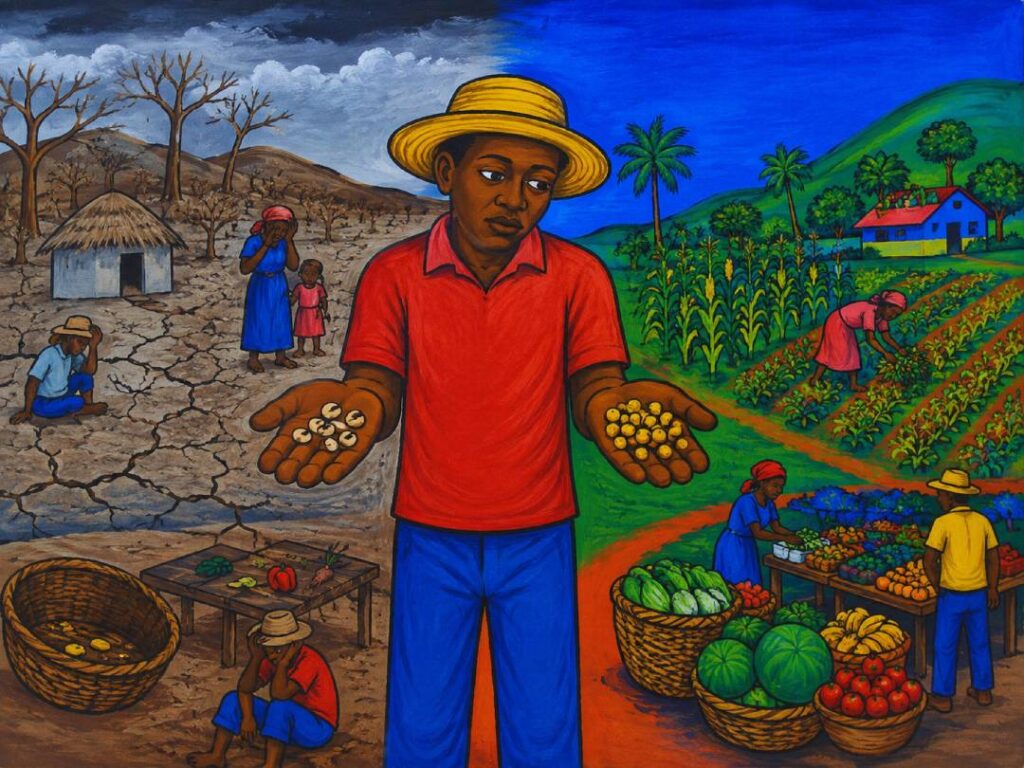
Haiti’s Silent Seed Crisis: Why the Foundation of Food Security is Crumbling
For a Haitian farmer, a seed is more than just a biological starting point; it is a vessel of hope and a generational inheritance. It is the promise that months of backbreaking labor will translate into food on the table and a small surplus to sell at the local market. But today, when a farmer reaches into their satchel to begin planting, that promise is increasingly fragile.
Across Haiti’s rural heartlands, a quiet crisis is unfolding. It isn’t as visible as a storm or as loud as a political protest, but its impact is just as devastating. Farmers are struggling to find quality seeds—seeds that are resilient, adapted to the local climate, and capable of producing a reliable harvest. Without a strong foundation of seeds, the entire food system begins to shake, leaving families vulnerable and rural economies in a state of constant uncertainty.
The Short Answer
Haiti’s seed crisis is the result of a breakdown in the systems that once allowed farmers to save, share, and improve their own planting materials.
- Loss of Local Varieties: Traditional “Creole” seeds, which are naturally adapted to Haiti’s microclimates, are disappearing due to environmental stress and poverty.
- Market Dependency: Many farmers are forced to buy expensive, imported seeds that often require chemical fertilizers they cannot afford or aren’t suited for the local soil.
- Climate Instability: Increasing droughts and erratic rainfall make it harder for farmers to save seeds from one season to the next.
- Economic Strain: When a harvest fails, farmers lose not just their food, but their “seed bank” for the following year, creating a cycle of debt and dependency.
The core thesis is that food security in Haiti cannot be achieved through aid alone; it requires a resilient, locally-managed seed system that empowers farmers to maintain their own agricultural heritage.
Comparing Local and Commercial Seed Systems
| Seed Type | Primary Sourcing | Climate Resiliency | Economic Impact on Farmer |
|---|---|---|---|
| Creole (Native) | Saved and shared locally | High (adapted to local soil and pests) | Promotes self-sufficiency and local wealth |
| Commercial / Hybrid | Purchased from global markets | Variable (requires external fertilizers/inputs) | Creates seasonal debt and market dependency |
The Weight of a Failed Harvest
Imagine the weight of choosing between eating your remaining corn to stave off hunger today or saving it to plant for a harvest that might not come for four months.
When we talk about agriculture, it is easy to get lost in statistics about yields and GDP. But for the smallholder farmer, the crisis is deeply personal.
In the past, Haitian communities had robust informal seed networks. Neighbors traded seeds, and families passed down varieties that had survived decades of local conditions. However, as farming in Haiti has become increasingly difficult, these networks have frayed. When poverty forces a family to eat their seed stock to survive a lean season, they aren’t just losing a meal—they are losing their future.
The Cycle of Seed Dependency
The seed crisis is not an isolated event; it is a self-perpetuating cycle. Understanding this pattern helps explain why food insecurity in Haiti has such deep drivers.
The Dependency Cycle:
- Harvest Failure: Drought or poor-quality seeds lead to a low yield.
- Seed Depletion: The farmer is forced to eat or sell the seeds they would usually save for the next season.
- Market Pressure: To plant again, the farmer must buy seeds from the market, which are often imported and expensive.
- Resource Drain: To afford these seeds, the farmer may take on debt or skip necessary soil amendments.
- Vulnerability: These imported seeds may not be adapted to local pests or climate change risks in Haiti, leading to another poor harvest and repeating the cycle.
This loop turns a seasonal challenge into a structural trap, where the farmer works harder each year for a smaller and more uncertain return.
The Loss of the “Creole” Seed
One of the most concerning aspects of this crisis is the decline of “Creole” or native seeds. These varieties are the result of centuries of natural selection. They “know” the Haitian soil; they have a memory of the local pests and the specific timing of the rains.
As these local varieties are replaced by commercial hybrids, Haiti loses more than just biodiversity. Commercial seeds are often designed to be “one-season” products—they don’t always produce viable seeds for the next year. This forces the role of smallholder farmers in Haiti to shift from being self-sufficient producers to being dependent consumers in a global supply chain they cannot control.
What This Means for the Future of Food
If the foundation of the food system—the seed—is compromised, every other intervention becomes less effective. Irrigation systems, better tools, and even training can only do so much if the seed itself is weak or ill-suited for the environment.
A seed crisis is, at its heart, a resilience crisis. A community that can grow its own food from its own seeds is a community that can withstand external shocks. When those seeds are lost, the path to a sustainable development roadmap for Haiti becomes much harder to navigate.
Donate to Haiti
Your gift will help address food security and economic development in Haiti. $100 can help give a Haitian family seeds for planting their own crops. $150 can provide a rooster and a hen for a family to begin breeding chickens.
Joining Hands with The Haitian Development Network Foundation
The Haitian Development Network Foundation (HDN), a registered U.S. 501(c)(3) nonprofit, views the seed crisis as a systemic challenge that requires a community-led solution. We believe that supporting farmers means more than just giving them seeds—it means helping them rebuild the systems that keep those seeds healthy and available for years to come.
Through its IRS-approved intervention areas, HDN supports the following initiatives to restore Haiti’s agricultural foundation:
1. Community Seed Banks and Storage
HDN supports the creation of local seed banks where farmers can safely store their Creole seeds in climate-controlled or pest-protected environments, ensuring they have a “reserve” for the next planting season.
2. Agroforestry and Nursery Support
By supporting nurseries that produce high-quality seedlings for fruit and forest trees, HDN helps farmers diversify their land, which provides natural shade and soil stability for their delicate grain crops.
3. Technical Training in Seed Selection
HDN works with local cooperatives to provide training on how to select and save the best seeds from each harvest, reviving the traditional knowledge that has been lost in recent decades.
4. Soil Regeneration for Seed Health
A seed is only as good as the soil it is planted in. HDN’s focus on organic composting and erosion control ensures that quality seeds have the nutrients they need to reach their full potential.
5. Rural Infrastructure and Market Access
By improving the infrastructure that connects rural farmers, HDN helps strengthen the informal networks where seeds are traded, ensuring that a surplus in one valley can help a shortage in the next.
Ready To Restore Haiti’s Agricultural Foundation?
Every harvest begins with a single, healthy seed. By supporting the systems that protect and improve local seeds, we aren’t just helping farmers grow food—we are helping them grow independence and resilience.
Donate to Haiti
Your gift will help address food security and economic development in Haiti. $100 can help give a Haitian family seeds for planting their own crops. $150 can provide a rooster and a hen for a family to begin breeding chickens.