
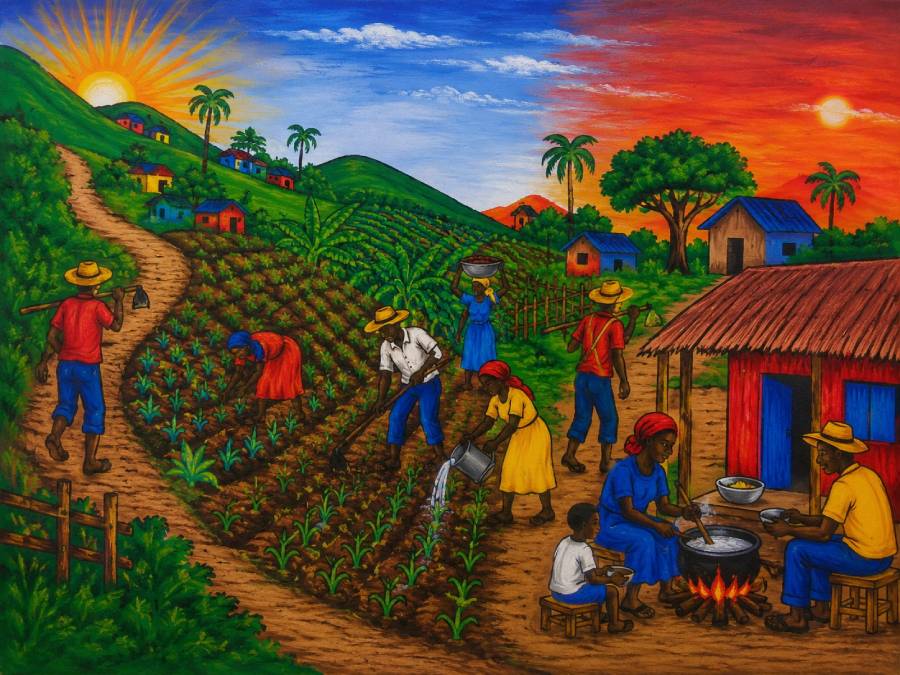
A Day in the Life of a Haitian Farmer: Strength, Skill, and Quiet Resilience
Across Haiti, smallholder farmers rise before dawn, carry simple tools across steep hillsides, and work land their families have tended for generations. Their days are long, physical, and shaped by the environment around them, fragile soils, unpredictable rains, limited infrastructure, and rising input costs. Yet behind every harvest is a story of quiet resilience and deep skill.
This explainer walks you through a typical day in the life of a Haitian farmer, showing not only the work they do, but the systems they depend on, systems that align directly with HDN Foundation’s IRS‑approved areas: food security, family agriculture, agroforestry, technical training, sanitation, waste-to-energy, and rural infrastructure.
The Short Answer
Behind every crop planted and every market sale is a full day of labor, skill, community cooperation, and hope.
A Haitian farmer’s day is shaped by five realities:
- Difficult terrain and fragile soil
- Work done almost entirely with manual tools
- Long distances between home, water, and fields
- Disruptions from weather, disasters, and poor infrastructure
- A continuous need to adapt, solve problems, and plan ahead
Before Sunrise: Preparation, Coffee, and Quiet Planning
Most farmers start their day between 4:00 and 5:00 AM. The home is dark; charcoal embers are coaxed back to life. A small pot of strong Haitian coffee brews.
Sitting quietly in the early morning, farmers mentally review:
- Whether the soil is dry enough to plant
- Which field needs attention
- If rain is expected, or if irrigation buckets will be needed
- Whether the road or footpath is safe to travel
This planning is essential. With little infrastructure and no mechanization, each decision shapes the entire day’s productivity.
The Walk to the Field: Distance, Terrain, and Time
Most Haitian farmers walk 15 to 45 minutes, sometimes longer, to reach their plots. The journey is often through:
- Narrow, rocky footpaths
- Eroded hillsides
- Steep climbs
- Riverbeds or damaged roads
Carrying a hoe, machete, seeds, or water, the walk itself is a physical challenge.
Rural infrastructure, small bridges, feeder roads, water points, makes a major difference here. Stronger infrastructure reduces isolation and connects farmers to markets, training, and essential services.
Early-Morning Fieldwork: Soil, Tools, and Technique
Once at the field, the day’s primary work begins. A farmer may:
- Loosen compacted soil with a hoe
- Clear stones carried downhill by recent rains
- Check young plants for pests or dryness
- Reinforce terraces damaged by storms
Every action is informed by deep generational knowledge. Farmers read the land instinctively, its color, moisture, slope, and texture.
But they work with minimal tools, often just a hoe and machete. Technical training can greatly increase efficiency and improve soil health.
Planting, Watering, and Managing Risk
Depending on the season, farmers plant:
- Maize
- Beans
- Sorghum
- Cassava
- Yam
- Plantain
With no irrigation systems, watering is often done by hand. Timing must match rainfall cycles, a risky calculation in Haiti’s unpredictable climate.
Agroforestry systems help stabilize this risk. Shade trees reduce heat stress on crops, improve soil moisture, and diversify income.
Mid-Morning Pause: Konbit, Community, and Shared Labor
Around mid-morning, farmers pause for a small snack, cassava, fruit, or leftover rice. This is also when konbit occurs: traditional shared labor where neighbors work one another’s plots in rotation.
Konbit strengthens social bonds and improves productivity. It is community-led development at its most organic.
Communication systems, radios, local networks, mobile alerts, help farmers coordinate labor, weather updates, and market information.
Repairing Storm Damage: Erosion, Terraces, and Water Management
A significant part of a farmer’s day is spent repairing, not just planting.
Farmers must:
- Rebuild terraces
- Reinforce drainage channels
- Fill gullies
- Stabilize slopes
- Reconstruct small dams
This routine maintenance prevents further soil loss. HDN’s interventions in soil regeneration, agroforestry, and watershed management directly support these efforts.
Donate to Haiti
Your gift will help address food security and economic development in Haiti. $100 can help give a Haitian family seeds for planting their own crops. $150 can provide a rooster and a hen for a family to begin breeding chickens.
Midday Return Home: Heat, Water, and Household Tasks
By noon, the heat becomes intense. Farmers gather tools and walk home to:
- Tend livestock
- Fetch water (often from far distances)
- Prepare meals
- Handle sanitation needs
- Rest briefly before afternoon chores
Poor sanitation and lack of clean water directly affect productivity, health, and food security. WASH improvements reduce illness and labor loss, supporting stronger agricultural output.
Afternoon Work: Livestock, Markets, and Microbusiness
Afternoons are dedicated to:
- Feeding goats, pigs, chickens, or cows
- Collecting fodder
- Repairing fences
- Visiting local markets to buy or sell goods
Some farmers also engage in small home-based enterprises:
- Cassava bread making
- Peanut butter production
- Fruit drying
- Charcoal alternatives (e.g., briquettes from agricultural waste)
These activities reinforce family income. Waste-to-energy initiatives can further reduce fuel costs and open new rural microbusiness opportunities.
Evening: Family Time, Review, and Hope for Tomorrow
As the sun sets, families gather for a simple meal, often rice, beans, plantains, or leafy greens.
After dinner, farmers review:
- What worked today
- What failed
- What adjustments tomorrow requires
- Whether they need to call on neighbors for help
- Whether rain is coming or work needs to shift
Despite daily challenges, farmers carry a deep sense of dignity and pride in their work. Their days end with hope and resolve to start again before dawn.
The Bigger Picture: What This Day Tells Us
A Haitian farmer’s day shows why family agriculture is so precarious:
- Long distances
- Fragile land
- High physical demands
- Limited infrastructure
- Climate unpredictability
- Minimal financial buffers
- Lack of technical support
And yet, the strength, skill, and endurance of Haitian farmers remain the backbone of national food security.
Supporting them means investing in systems, not charity.
How HDN Foundation Supports Farmers Through IRS‑Approved Interventions
The Haitian Development Network Foundation (HDN), a registered U.S. 501(c)(3) nonprofit, strengthens smallholder farmers by focusing on IRS‑approved intervention areas: food security, family agriculture, agroforestry, technical training, sanitation, energy extraction from waste, infrastructure, and communications.
Here’s what that looks like on the ground:
1. Soil Regeneration and Agroforestry
HDN promotes soil regeneration because healthy land is the base of all food security. Through contour planting, mulching, compost, intercropping, and tree integration, HDN helps rebuild degraded soils, stabilize hillsides, and diversify farmer income with fruit, timber, and agro-processing opportunities.
Healthy soil strengthens yields and protects communities from disasters.
2. Farmer Training and Field‑Based Learning
HDN invests in practical training programs rooted directly in farm realities, improving skills in irrigation, pest control, soil management, composting, post-harvest handling, and agro-processing.
This field-based approach, aligned with Article 32‑7, equips farmers with the tools needed to adapt to climate stress and increase production.
3. Rural Infrastructure and Market Access
HDN supports infrastructure like small roads, feeder paths, irrigation canals, storage facilities, and local communication systems.
When farmers can travel safely, store produce longer, and access market information, they gain fairer prices and reduce losses.
4. Food Security and Sanitation Integration
Food security requires healthy, stable households. HDN strengthens WASH systems, safe drinking water, sanitation facilities, hygiene education, and clean cooking options, reducing disease burdens and improving labor capacity.
Healthy families support stronger agricultural economies.
5. Exploring Sustainable Energy From Agricultural Waste
HDN promotes waste-to-energy solutions such as biogas digesters and biomass briquettes.
These innovations convert crop residues into clean fuel, reducing household costs, dependence on charcoal, and environmental degradation, while creating rural microbusiness opportunities.
Ready To Support Farmers in Haiti?
A day in the life of a Haitian farmer is demanding, skilled, and deeply rooted in community. Their resilience is remarkable, but resilience alone cannot sustain Haiti’s agriculture.
By strengthening soils, training farmers, improving infrastructure, enhancing sanitation, and expanding sustainable energy, HDN Foundation works to ensure farming in Haiti becomes not only survivable, but sustainable, profitable, and dignified.
Standing with farmers is standing with Haiti’s future. Your contribution matters.
Donate to Haiti
Your gift will help address food security and economic development in Haiti. $100 can help give a Haitian family seeds for planting their own crops. $150 can provide a rooster and a hen for a family to begin breeding chickens.