
7 Key Phases in the History of Deforestation in Haiti
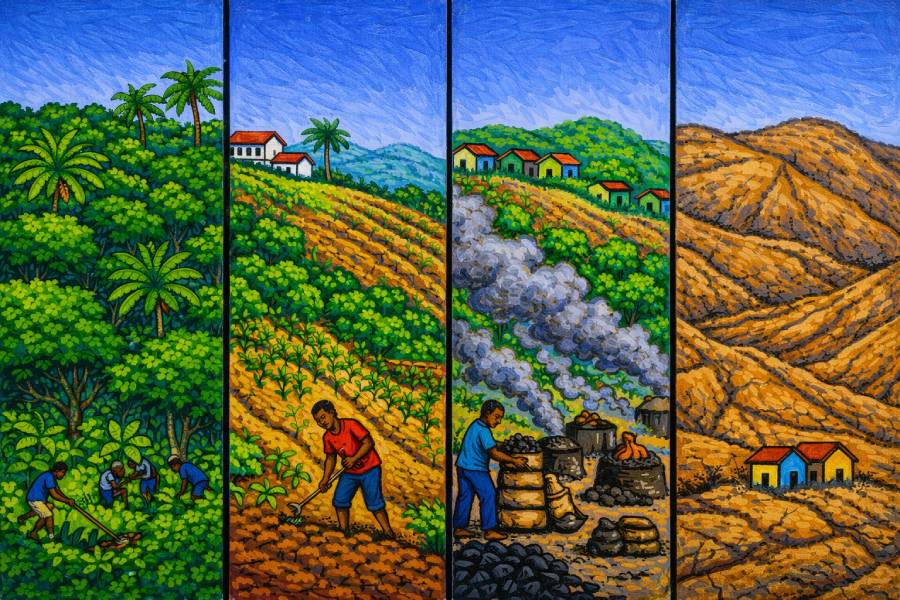
Satellite images of Hispaniola often show a sharp contrast between greener areas and more barren hillsides. On the Haitian side of the island, this difference is the product of a long history, not a single event. Forests have been cleared, regrown in places, and cleared again under different political and economic systems.
For readers trying to understand how Haiti moved from heavily forested mountains to today’s fragmented landscapes, it helps to think in phases. Each period had its own drivers of tree loss—plantations, timber exports, charcoal, population pressure—and each phase left a mark on the land that the next phase inherited.
This article offers a long‑form, chronological overview of deforestation in Haiti, organized into seven key phases, and shows how they connect to the country’s current environmental challenges.
The Short Answer
- Haiti’s deforestation has unfolded over centuries, starting with colonial plantations and continuing through post‑independence logging, rural expansion, and a charcoal‑based energy system.
- Each phase changed how land was used, how forests were valued, and how people interacted with hillsides, rivers, and coasts.
- Soil erosion, flood risk, declining agricultural productivity, and ecosystem degradation are cumulative results of these phases, not isolated problems.
- Deforestation is closely tied to political economy: land distribution, export demands, energy choices, and state capacity all shaped how and why trees were cut.
In essence, deforestation in Haiti evolved through distinct historical phases, each building on the last, creating a pattern where economic survival and weak institutions repeatedly drove forest loss and environmental decline.
Phase 1: Pre‑Colonial Forests and Early Colonial Clearing
Before intensive European colonization, the island of Hispaniola, including the territory that is now Haiti, was covered largely by tropical and subtropical forests. Indigenous Taíno communities used the land for agriculture, hunting, and gathering, but their practices did not clear forests at the scale seen later.
With the arrival and expansion of European powers:
- Initial clearing focused on establishing settlements, small‑scale agriculture, and early resource extraction (including timber and dyewoods).
- Forests were still extensive, but the foundations were laid for more intensive use as the colonial economy took shape.
In this early phase, the landscape shifted from predominantly forest to a patchwork of forest and cleared areas around settlements and coastal zones, setting the stage for large‑scale plantation agriculture.
Phase 2: Plantation Expansion and Large‑Scale Forest Conversion (18th Century)
By the 18th century, the French colony of Saint‑Domingue (today’s Haiti) had become one of the world’s most profitable plantation economies, focused on sugar, coffee, indigo, and later other crops.
This phase was marked by:
- Large‑scale clearing of lowland and mid‑elevation forests to make way for plantations.
- Construction of infrastructure—roads, mills, ports—that also used significant timber.
- High demand for wood as fuel in sugar processing and other colonial industries.
Forest cover declined substantially in areas suitable for plantations, especially:
- Fertile plains and lower mountain slopes.
- Regions near ports and trade routes, where access to markets made plantation agriculture more profitable.
While higher and more remote elevations remained forested, the pattern of clearing for export production established a model of land use where forests were primarily seen as resources to convert into economic value.
Phase 3: Revolution, Independence, and Post‑Plantation Landscapes (Late 18th – 19th Century)
The Haitian Revolution (1791–1804) ended slavery and colonial rule, transforming both society and land use. Plantations were damaged, abandoned, or reorganized, and the new Haitian state faced economic isolation and heavy financial pressures, including the later indemnity to France.
In this phase:
- Many former plantation lands were broken into smaller plots or occupied informally by former enslaved people and their descendants.
- Large‑scale plantation clearing slowed, but forest regeneration was limited in many areas because land remained under cultivation or grazing.
- Timber extraction and clearing for smallholder agriculture continued, though at a different scale and structure than under plantations.
Key dynamics included:
- A shift from concentrated plantation clearing to more dispersed, smallholder‑driven clearing.
- Continued use of forests for fuel, building materials, and agriculture, without systematic replanting or management.
- Limited state capacity for environmental regulation or land‑use planning.
The landscape became more fragmented: fewer intact plantations, more mixed agro‑mosaic systems, and forests increasingly confined to steeper, less accessible terrain.
Phase 4: Timber, Export Pressures, and State Revenue (19th – Early 20th Century)
As the 19th century progressed, the Haitian state sought revenue through customs, exports, and, at times, timber and other natural resources. External and internal economic pressures influenced how forests were used.
During this period:
- Commercial logging for export and domestic use continued, including hardwood extraction.
- Forest products contributed to state revenue and private incomes, but often without sustainable management frameworks.
- Population growth and the expansion of smallholder farming led to further clearing at forest edges.
Institutionally:
- Forest and land governance structures were weak or under‑resourced.
- Political instability made long‑term environmental planning difficult.
- Short‑term fiscal needs often outweighed concerns about forest conservation.
Deforestation during this phase was less visible as dramatic clear‑cuts and more as a steady extension of the cleared frontier and thinning of remaining forests.
Phase 5: Population Growth, Rural Expansion, and the Charcoal Economy (Mid‑20th Century)
By the mid‑20th century, Haiti’s population was growing rapidly. Many people relied on small‑scale agriculture for subsistence and cash income, while urban areas expanded without extensive modern energy infrastructure.
Two trends accelerated deforestation:
- Rural expansion and hillside farming
- As prime agricultural lands became crowded or degraded, farmers expanded cultivation into higher, steeper slopes.
- Forests were cleared to create new plots, often without terraces or erosion control.
- Charcoal and fuelwood demand
- Charcoal became a central energy source for cooking, particularly in cities.
- Rural producers cut trees, often from common or under‑regulated lands, to supply urban charcoal markets.
This phase solidified a self‑reinforcing pattern:
Limited access to modern energy (A)
→ expansion of charcoal production (B)
→ accelerated tree cutting and forest degradation (C)
→ increased soil erosion and declining agricultural yields (D)
→ deeper rural poverty and reliance on low‑cost income from charcoal (A), and the cycle repeats.
By the late 20th century, this charcoal‑driven deforestation, combined with ongoing rural expansion, had reshaped large portions of Haiti’s uplands and mid‑elevation slopes.
Donate to Haiti
Your gift will help address food security and economic development in Haiti. $100 can help give a Haitian family seeds for planting their own crops. $150 can provide a rooster and a hen for a family to begin breeding chickens.
Phase 6: Environmental Awareness, Donor Projects, and Patchwork Responses (Late 20th Century)
From the 1970s onward, observers increasingly recognized Haiti’s environmental challenges. International organizations, NGOs, and Haitian institutions launched projects to address deforestation and erosion.
This phase included:
- Reforestation campaigns: tree‑planting initiatives in selected areas, often focused on fast‑growing species.
- Soil conservation and watershed projects: contour bunds, terraces, and check dams promoted in erosion‑prone regions.
- Environmental education and policy discussions about forest loss and land degradation.
However, responses often faced structural constraints:
- Many projects were time‑limited, depending on external funding cycles.
- Some efforts were top‑down, with limited local ownership or follow‑up maintenance.
- Underlying drivers—especially energy needs, land tenure, and rural poverty—remained largely unchanged.
The result was a patchwork landscape:
- Areas with visible project interventions and partial regeneration.
- Large zones where deforestation and degradation continued or even intensified.
- Growing public awareness but persistent gaps between policy aspirations and on‑the‑ground realities.
Phase 7: Climate Pressures, Urbanization, and the Present Landscape (21st Century)
In the 21st century, Haiti faces a convergence of environmental and socio‑economic pressures.
Key features of the current phase include:
- Climate variability and intense storms
- Hurricanes and extreme rainfall events strike more frequently and with greater intensity.
- On deforested slopes, these events cause severe erosion, floods, and landslides, further degrading land.
- Urban growth and continued charcoal use
- Urban populations have expanded, increasing demand for charcoal when alternative fuels are inaccessible or unaffordable.
- Charcoal supply chains reach deep into rural areas, driving ongoing tree cutting.
- Humanitarian crises and environmental vulnerability
- Disasters and political instability can divert attention and resources away from long‑term environmental management.
- Relief efforts address immediate needs but may not always integrate soil and forest restoration.
At the same time, there is a stronger recognition that environmental degradation, including deforestation, is interconnected with:
- Food security and rural livelihoods.
- Disaster risk and climate adaptation.
- Migration, urban planning, and social stability.
The present landscape reflects all previous phases: remnants of forest, extensive degraded hillsides, ongoing clearing in some areas, and local efforts at regeneration and conservation.
How These Phases Connect: Deforestation as a Historical System
Looking across the seven phases, a pattern emerges:
- Forests are initially viewed as abundant and are cleared to support export economies or subsistence needs.
- Short‑term demands—plantation profits, timber, charcoal, new farmland—take precedence over long‑term ecosystem health.
- As trees disappear, soils degrade and water systems change, reducing productivity and increasing risk.
- Lower productivity and higher risk contribute to poverty and instability, limiting state capacity and incentives for sustainable management.
- Faced with constrained options, communities and institutions return to further forest exploitation to meet immediate needs.
In simplified form:
Historical extraction (A)
→ forest loss and land degradation (B)
→ reduced productivity and greater vulnerability (C)
→ economic stress and institutional weakness (D)
→ renewed reliance on short‑term forest exploitation (A), and the cycle repeats.
Understanding deforestation as this kind of system, rather than a single event or purely “cultural” trait, clarifies why it has proven so difficult to reverse and why durable change must address underlying structures.
What This History Means for Today’s Environmental Choices
The history of deforestation in Haiti is not just a record of what has been lost. It also frames current choices:
- Restoration efforts must work with existing land uses and social realities, not with an imagined return to untouched forest.
- Policies that aim to reduce tree cutting need to consider energy substitutes, land rights, and economic alternatives for rural and urban households.
- Watershed management and climate adaptation planning are most effective when they incorporate historical land‑use patterns and the legacies of past phases.
By seeing today’s forest cover and degraded hillsides as the outcome of these phases, planners and communities can better identify where conservation is still feasible, where restoration is needed, and what mix of policies can realistically shift incentives over time.
Joining Hands with The Haitian Development Network Foundation
The Haitian Development Network Foundation (HDN) engages with deforestation and land degradation as long‑term, system‑driven challenges rather than isolated environmental issues. The historical phases outlined above inform how HDN thinks about soil regeneration and landscape work.
In practice, this means:
Recognizing historical constraints and opportunities: HDN approaches current projects with an understanding that farmers and communities operate within patterns shaped by centuries of land use, energy dependence, and institutional change. Solutions must be feasible within those realities.
Focusing on soil regeneration as a practical entry point: Rather than treating forests and soils separately, HDN supports approaches that rebuild soil health and vegetation cover together—through agroforestry, conservation agriculture, and watershed‑level planning.
Aligning environmental goals with livelihoods: HDN emphasizes initiatives where protecting or restoring tree cover also improves food security, income, and resilience. This alignment increases the likelihood that restored landscapes will be maintained over time.
Working through Haitian leadership and institutions: HDN positions itself as a partner to Haitian organizations, local leaders, and communities who are already addressing deforestation’s impacts. The aim is to strengthen local capacity, facilitate knowledge exchange, and connect community‑led efforts to broader networks and resources.
By joining hands in this way, the Haitian Development Network Foundation seeks to help move Haiti from a historical trajectory of recurring forest loss toward one of gradual regeneration, where forests and soils once again support more stable and resilient livelihoods.
On a Concluding Note
Deforestation in Haiti is often captured in a single image or comparison, but its origins lie in a sequence of phases that span plantations, independence, rural expansion, energy choices, and modern climate pressures. Each phase altered how forests were used and valued, and each left behind environmental and social legacies that shaped the next.
Understanding these phases does not provide easy solutions, but it offers a clearer map of how the landscape came to look as it does today and why reversing the trend is complex. Effective responses will need to address both the visible symptoms—bare hillsides, eroded soils, and frequent floods—and the underlying systems of land use, energy, governance, and livelihoods that have driven deforestation for generations.
In that sense, grappling with Haiti’s deforestation history is not only about explaining the past. It is about informing decisions now so that future generations inherit a landscape that is more stable, more productive, and better able to support the communities that depend on it.
Donate to Haiti
Your gift will help address food security and economic development in Haiti. $100 can help give a Haitian family seeds for planting their own crops. $150 can provide a rooster and a hen for a family to begin breeding chickens.