
10 Key Ways Deforestation Changed Haiti’s Environment and Economy
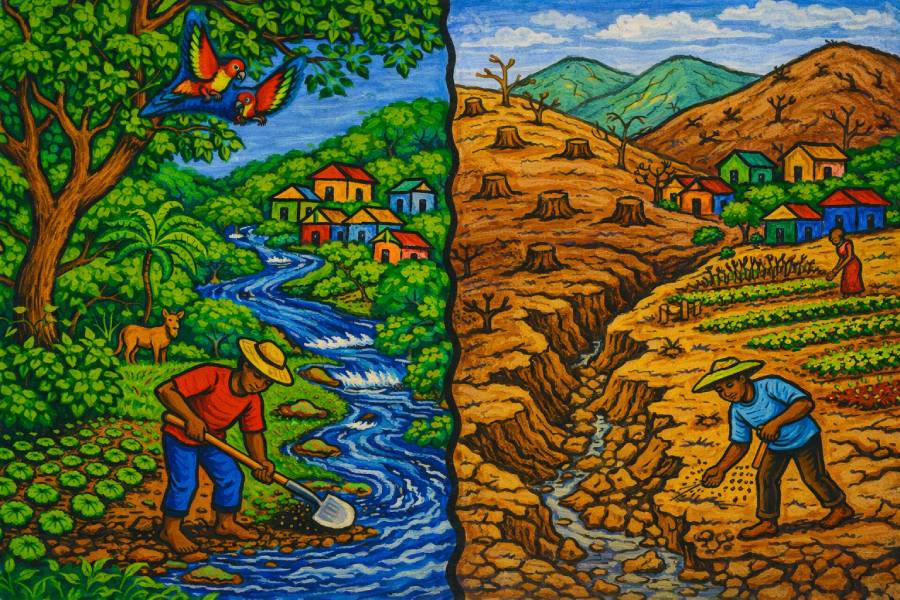
Many people first encounter Haiti’s environmental story through satellite images that show a stark contrast: greener areas on one side of the island, more barren slopes on the other. On the ground, the picture is even clearer—steep hillsides with scattered trees, exposed soils, and communities working hard on land that is increasingly fragile.
Deforestation in Haiti did not happen overnight. It is the result of centuries of extraction, shifting land use, energy needs, and economic pressures. Over time, the loss of tree cover has not only changed the appearance of the landscape; it has altered how water moves, how soil behaves, where people can farm, and how communities experience storms and droughts.
This listicle explains why deforestation has changed Haiti’s landscape so dramatically, step by step, and how these changes continue to shape daily life.
The Short Answer
- Haiti once had extensive forest cover; repeated cutting for plantations, timber, and charcoal has left many hillsides bare or sparsely vegetated.
- Without trees, soil is more easily washed away, streams respond more violently to rainfall, and floods and landslides become more frequent.
- Deforestation has reduced fertile land, damaged rivers and coasts, and forced farming and settlements into increasingly risky areas.
- These environmental shifts have, in turn, affected food security, disaster risk, migration, and economic prospects.
In short, deforestation in Haiti set off a chain reaction: trees were removed, water and soil systems changed, and that transformation of the land reshaped how people live, farm, and face both everyday weather and extreme events.
10 Impacts of Deforestation in Haiti on Land, Water, and Farming
Deforestation in Haiti is often discussed as a single issue—tree loss. In practice, its impact is much broader. Changes in vegetation affect how water moves, how soil behaves, where people can farm, and how communities experience both everyday weather and extreme events.
The points below break this process into a series of connected changes. Each one builds on the previous, showing how the removal of trees reshapes not just the landscape, but the systems that support livelihoods, infrastructure, and long-term development.
Rather than viewing these impacts in isolation, it is helpful to see them as part of a sequence: Tree loss → changes in water and soil systems → shifts in farming and settlement patterns → increased exposure to environmental risk
With that framework in mind, the following sections explain the key ways deforestation has transformed Haiti’s landscape.
1. From Dense Forests to Fragmented Hillsides
Historical accounts suggest that much of Haiti was once covered by tropical forests, especially in mountainous regions. Over centuries, this changed.
- Colonial plantations cleared large tracts for sugar, coffee, and other export crops.
- Post‑independence logging and charcoal production continued to remove trees, often without replanting.
- Population growth and land pressure pushed farming into forested areas.
The result is a mosaic of:
- Remaining forest patches, often in remote or steep locations.
- Degraded woodland and scrub.
- Hillsides with scattered trees and extensive bare soil.
This fragmentation matters because continuous forest cover functions very differently from isolated trees when it comes to protecting soil, regulating water, and supporting biodiversity.
2. How Tree Loss Changed the Way Water Moves
Trees shape the water cycle at the local level. When forests are removed, the behavior of rainfall changes.
With forest cover:
- Leaves and branches intercept rainfall, reducing its direct impact on the ground.
- Roots improve soil structure, allowing water to infiltrate and recharge groundwater.
- Forest soils act like a sponge, releasing water gradually into streams.
With deforested hillsides:
- Rain falls directly on bare or lightly covered soil, increasing surface runoff.
- Compacted or degraded soils absorb less water, so more flows over the surface.
- Streams and rivers receive sudden pulses of water, rather than steady flows.
This shift has visible consequences:
- Flash floods become more common after heavy rains.
- Low flows in dry periods are more pronounced, affecting water availability.
- River channels erode and shift more rapidly, threatening nearby land and infrastructure.
Over time, deforestation has helped turn some watersheds into systems where water alternates between scarcity and destructive excess.
3. Soil Erosion: When the Ground Itself Starts to Move
One of the most immediate effects of deforestation is soil erosion. Tree roots and ground cover hold soil in place; without them, soil is more easily dislodged and transported downslope.
On deforested slopes in Haiti:
- Raindrops hit exposed soil directly, breaking up aggregates.
- Runoff water carries loosened particles downhill, forming rills and gullies.
- With each storm, a thin layer of topsoil is lost.
This leads to a gradual but persistent transformation:
- Fields become shallower and rockier, making cultivation harder.
- The most fertile layer is removed, leaving less productive soil behind.
- Landslides can be triggered on steep, saturated slopes.
The landscape shifts from deep, forested soils to thin, eroded profiles that struggle to support crops and vegetation.
4. Rivers, Sediment, and Changing Channels
Soil eroded from hillsides does not simply disappear; it accumulates in rivers, canals, and coastal areas.
Deforestation accelerates:
- Sedimentation in rivers and streams: channels fill with material, reducing their capacity to carry water.
- Clogging of irrigation and drainage systems: canals and ditches require constant clearing.
- Changes in river paths: sediment deposits can redirect flow, sometimes closer to settlements or fields.
The consequences are:
- Higher flood risk during storms, as rivers overflow more easily.
- Increased maintenance costs for infrastructure such as canals and small dams.
- Greater uncertainty for communities living near rivers whose behavior has become more unpredictable.
In this way, deforestation upstream reshapes landscapes downstream, even far from the original forest clearing.
5. From Forest Wildlife to Simplified Ecosystems
Forests provide habitat for a wide array of plants and animals. As deforestation progresses, these ecosystems become simplified.
On heavily deforested slopes, the landscape may shift from:
- Diverse forest species →
- Shrubs and grasses with scattered trees →
- Dominance of a few hardy species and invasive plants.
This affects:
- Pollination and seed dispersal, which are important for both wild and cultivated plants.
- Pest and disease dynamics, as the balance of species changes.
- Availability of non‑timber forest products such as fruits, medicinal plants, and construction materials.
The visible outcome is a landscape with fewer ecological functions, which reduces its capacity to recover from shocks and support varied livelihoods.
6. Farming Higher, Steeper, and on Thinner Soils
As forests are cleared and soils degrade, communities often adapt by moving cultivation into new areas.
Deforestation and erosion can set off a chain:
- Productive land on lower, gentler slopes becomes degraded.
- Farmers move uphill or onto steeper slopes in search of better soil.
- New land clearing removes remaining tree cover, exposing fresh soil to erosion.
Over time, this pattern can be summarized as:
Deforestation on accessible land (A)
→ leads to soil degradation and lower yields (B)
→ which pushes cultivation into higher, steeper, more fragile areas (C)
→ accelerating new deforestation and erosion (D)
→ which returns to greater degradation and land scarcity (A), and the cycle repeats.
This cycle helps explain why deforestation in Haiti has led not only to a loss of forest but also to a progressive shift of agriculture into increasingly marginal terrain.
Donate to Haiti
Your gift will help address food security and economic development in Haiti. $100 can help give a Haitian family seeds for planting their own crops. $150 can provide a rooster and a hen for a family to begin breeding chickens.
7. More Frequent and Destructive Floods and Landslides
When forests are removed and soils are degraded, the landscape becomes more sensitive to extreme weather.
Deforested slopes contribute to:
- Faster runoff, sending larger volumes of water into rivers in a shorter time.
- Greater landslide risk, especially where slopes are steep and soils are saturated.
- Debris flows, where water, mud, and stones move together downslope.
This changes how communities experience storms:
- Events that might once have caused limited damage now trigger severe floods or landslides.
- Settlements, roads, and bridges located near rivers or at the base of slopes are more exposed.
- Recovery becomes more difficult when disasters are frequent and cumulative.
Deforestation thus plays a central role in the pattern where routine rainy seasons can produce repeated emergencies.
8. Coastal Changes: Sediment, Reefs, and Fisheries
Deforestation inland also affects Haiti’s coasts. Sediment carried by rivers eventually reaches the sea.
This can result in:
- Sediment plumes near river mouths, turning clear water turbid.
- Smothering of coral reefs and seagrass beds, which need light and clean water to thrive.
- Changes in coastal geomorphology, such as the growth or erosion of deltas and beaches.
These changes have economic implications:
- Coral reef degradation can reduce fish populations that many coastal communities rely on.
- Loss of natural coastal protection can leave shorelines more vulnerable to storm surges.
- Ports, fishing harbors, and coastal infrastructure may require more frequent dredging.
In this way, tree cutting on hillsides can, over time, influence the productivity and safety of communities hundreds of kilometers away along the coast.
9. Urban Pressures and Fuel Demand
Deforestation is not driven only by rural needs. Urban and peri‑urban growth also contributes.
Key links include:
- Charcoal demand from cities and towns: urban households often rely on charcoal for cooking, creating steady demand for wood from rural areas.
- Construction materials: timber and poles from remaining forest patches can be extracted for building purposes.
- Informal expansion: as people move to cities from degraded rural areas, unplanned settlements can appear on hillsides around urban centers, sometimes contributing to further tree removal.
This amplifies the connection between environmental change and demographic shifts:
- Degraded rural land and limited livelihoods encourage migration to cities.
- Growing urban populations increase demand for charcoal and timber, which drives further deforestation in rural zones.
- The pressure on both rural and peri‑urban landscapes intensifies over time.
The landscape transformation is therefore both a cause and a consequence of broader social and economic dynamics.
10. A Landscape that Reflects Historical Choices
Taken together, these processes explain why deforestation has changed Haiti’s landscape so dramatically:
- Hillsides have shifted from forested to sparsely vegetated.
- Soils have gone from deep and resilient to thin and erosion‑prone.
- Rivers have become more unstable, with irregular flows and heavy sediment loads.
- Coasts have experienced changes in sedimentation and ecological health.
- Farming patterns, settlement locations, and risk exposure have all been reshaped.
The current landscape is the visible outcome of long‑term choices and constraints around land use, energy, governance, and livelihoods—not simply the result of recent events.
What This Means Today
The legacy of deforestation continues to influence Haiti’s development choices:
- Agricultural planning must account for degraded soils and fragile slopes, emphasizing conservation and restoration.
- Disaster risk management must recognize how land cover affects flood and landslide frequency and severity.
- Urban and energy policy must consider how charcoal demand and urban growth link back to rural tree loss.
- Climate adaptation strategies cannot be separated from reforestation, soil regeneration, and watershed management.
In practice, this implies shifting from viewing deforestation as a technical forestry issue to treating it as a structural challenge that spans agriculture, energy, planning, and social policy.
Joining Hands with The Haitian Development Network Foundation
The Haitian Development Network Foundation (HDN) engages with deforestation as a system‑level challenge that connects soil health, water management, food security, and resilience.
In this context, HDN’s soil regeneration and landscape work emphasizes:
Rebuilding soil and vegetation together
HDN supports approaches that combine tree planting, agroforestry, and soil conservation practices, recognizing that trees, crops, and ground cover must work as a system to stabilize slopes and restore productivity.
Supporting watershed‑oriented thinking
Rather than treating each farm or village in isolation, HDN aligns with efforts to think in terms of watersheds—understanding how interventions upstream affect flooding, sedimentation, and water availability downstream.
Linking environmental action to livelihoods
HDN promotes solutions where reforestation and soil regeneration are tied to tangible benefits for communities: improved yields, access to fruit and timber, alternative income sources, and reduced disaster losses.
Standing behind Haitian leadership
HDN positions itself as a partner to Haitian organizations, farmers, and local leaders who are already working to restore degraded lands. The focus is on strengthening local capacity, sharing knowledge, and connecting initiatives with resources, rather than directing them from the outside.
By joining hands with Haitian communities in this way, the Haitian Development Network Foundation seeks to help move from a pattern of ongoing deforestation and degradation toward one of gradual regeneration, more stable watersheds, and healthier rural and coastal landscapes.
On a Concluding Note
Deforestation in Haiti has changed far more than the view from the hillside. It has altered how rain falls and flows, how soil behaves, where crops can grow, and how communities experience everyday weather and extreme events. The current landscape is the product of a long sequence of decisions shaped by historical, economic, and institutional forces.
Understanding this transformation as a connected system—trees, soil, water, farms, cities, and coasts—helps explain why reversing the trend is challenging, but also where the most effective interventions lie. Efforts that regenerate soil, restore tree cover, and strengthen local institutions do more than improve the environment; they create a more stable foundation for food security, risk reduction, and long‑term development.
In that sense, the story of deforestation in Haiti is not only about loss. It is also about the possibility of redesigning the relationship between people and land so that future generations inherit a landscape that is more resilient, more productive, and better able to support the lives built upon it.
Donate to Haiti
Your gift will help address food security and economic development in Haiti. $100 can help give a Haitian family seeds for planting their own crops. $150 can provide a rooster and a hen for a family to begin breeding chickens.